The platform powering Connected Funding
The Connected Journey, in product form.
Everything below is live in the product today — each area one stage of the same journey, working the same shared record. The theme throughout: information that stays connected instead of being re-keyed, and a record either side can verify without taking anyone's word for it.
Programme design→Application→Assessment→Award→Delivery & evidence→Reporting→Impact
Winning the money
Programmes, applications & assessment
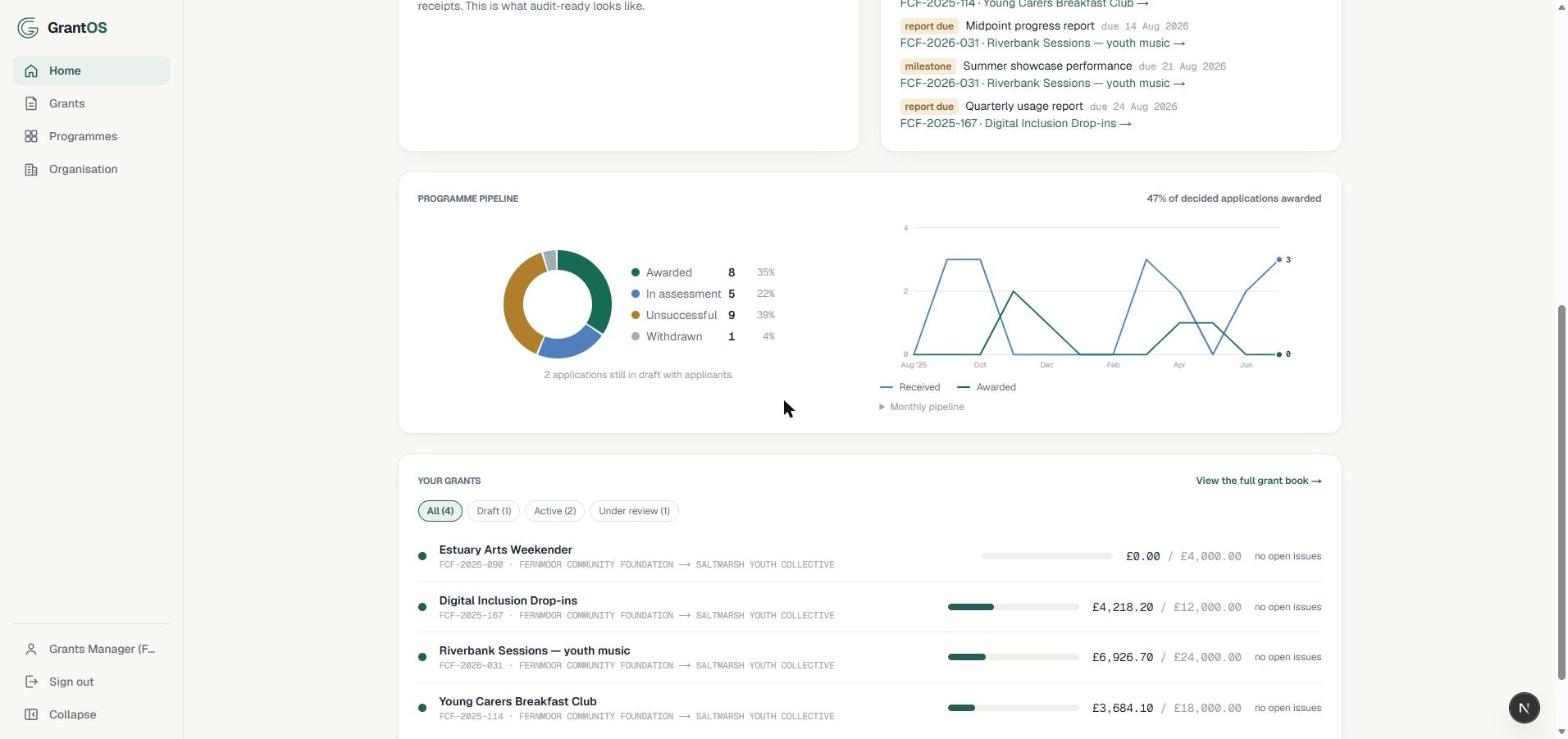
- Programme designer — budget envelope, award range, windows, machine-readable eligibility, per-stage questions and weighted criteria — with a design review that flags applicant burden and unassessable stages before you publish.
- Open application link — a charity that has never seen GrantOS applies through one URL, creating its account and organisation as it goes — email-code verified, authenticator secured.
- Eligibility in minutes, not after the deadline — rules checked live against the applicant's passport and answers; unknowns show honestly as needs-review, never a silent pass.
- Two-stage EOI → full — a short expression of interest sifts the field before anyone writes the full form; invited applicants continue on the same record.
- Assessment on the record — frozen, hashed submissions; conflict-of-interest declared before an application unseals (and applicant-org members refused automatically); side-by-side weighted scores; every decision carries its rationale.
- Award → live grant, one click — conditions register, milestones, reporting calendar and payment schedule minted from the design plus the application. The charity accepts the award by confirming the record.
The agreement
Grant setup & the conditions register
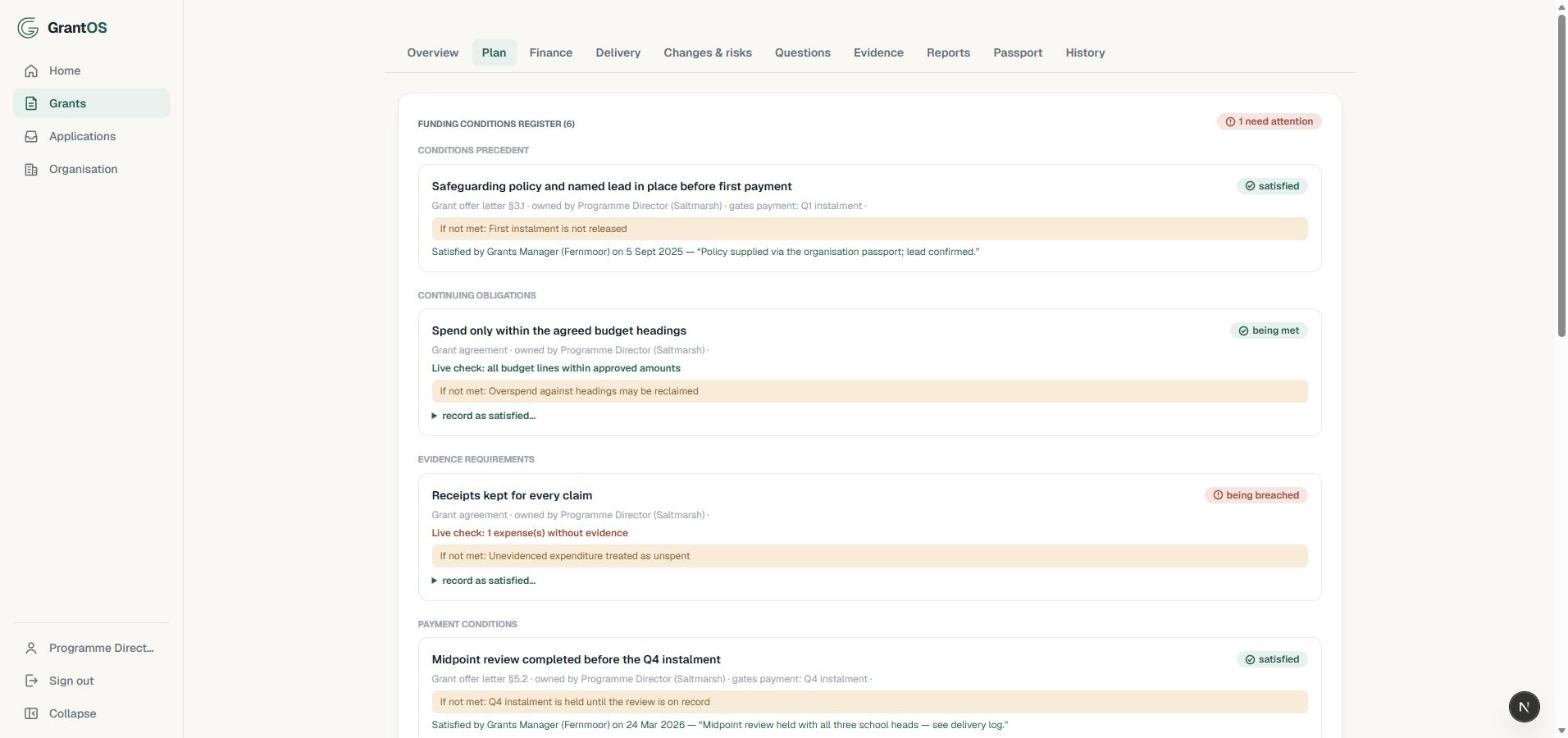
- 10 grant archetypes, 21 overlays, 12 funding regimes — restricted project, capital, multi-year, research, consortium, outcome-based and more — each generating its own compliance shape, proportionate to size and risk.
- Machine-readable conditions — every string attached to the money with its source clause, owner, deadline and — crucially — the consequence of non-compliance stated up front.
- Live rule-linked conditions — conditions tied to the rules engine show being met or being breached right now, from real spend and delivery data.
- Payment-gating conditions — a condition can block a payment, depend on another, and attach to a specific instalment — surfaced on decisions, never blocking the recording of reality.
The money
Finance without payment rails
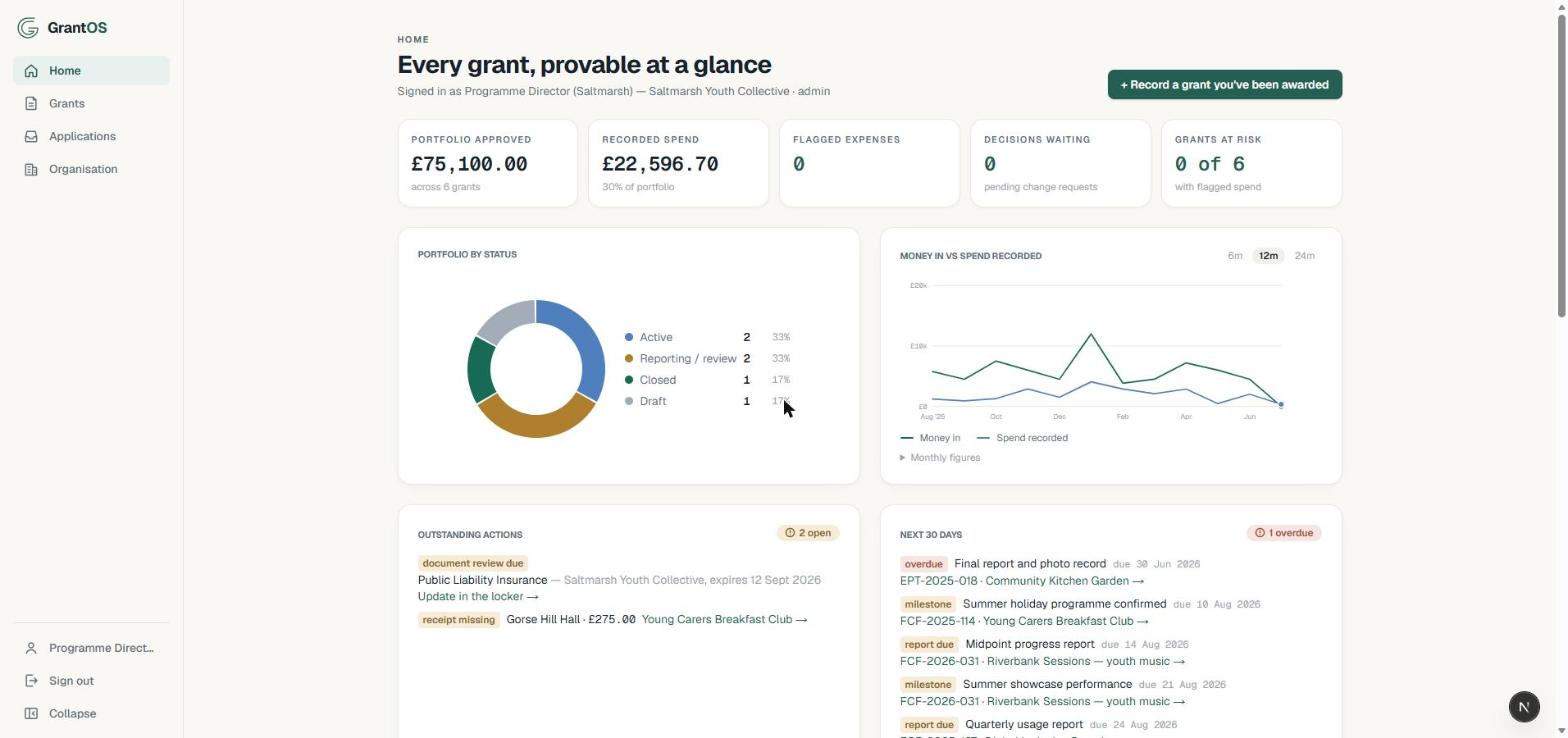
- Payment schedule — expected instalments with triggers — signing, report acceptance, milestones, retention release — receipts recorded by the charity, shortfalls visible.
- Deterministic compliance checks — out-of-window, over-budget-line, possible duplicate, missing evidence — explainable rules, re-run when the baseline changes.
- Burn & pacing — window-elapsed versus spend drift surfaces before it becomes a clawback conversation.
- Review signals, not accusations — grant-level patterns — round numbers, supplier concentration, end-loaded spend — framed as prompts for the charity to get ahead of.
The work & the proof
Delivery, outcomes & evidence
- Activity log — date, venue, headcount, evidence; unapproved venues flagged; late logging marked backdated, honestly.
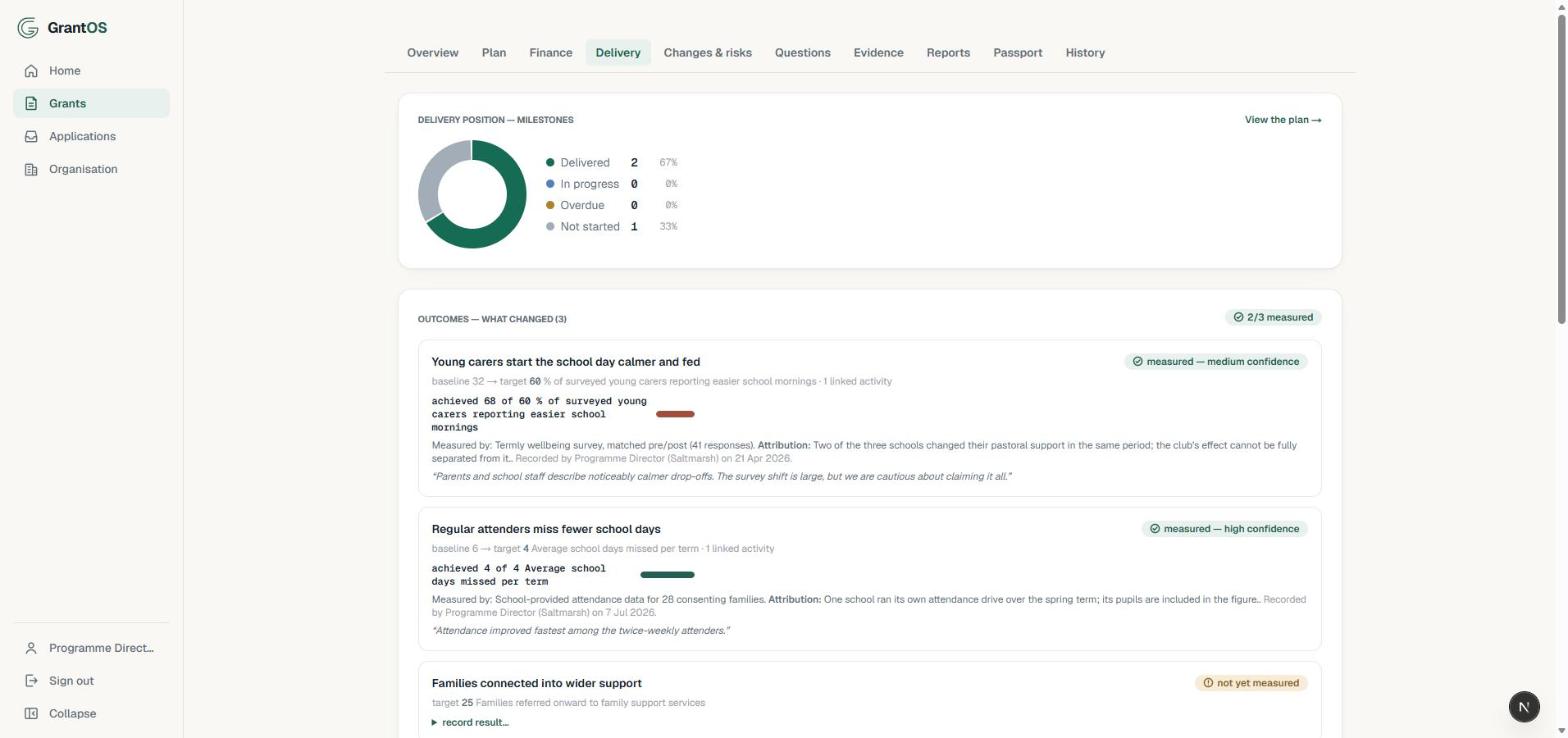
- Outcomes with honest attribution — outputs (sessions run) separate from outcomes (what changed); every measurement carries its method, a confidence rating and an attribution note.
- Write-once evidence, SHA-256 hashed — integrity re-verified on every download; withdrawal and replacement happen on the record.
- Upload once, evidence many — one attendance register can support a milestone, a condition, a report and an outcome — the single biggest burden-killer for charities.
When reality diverges
Changes, risks & questions
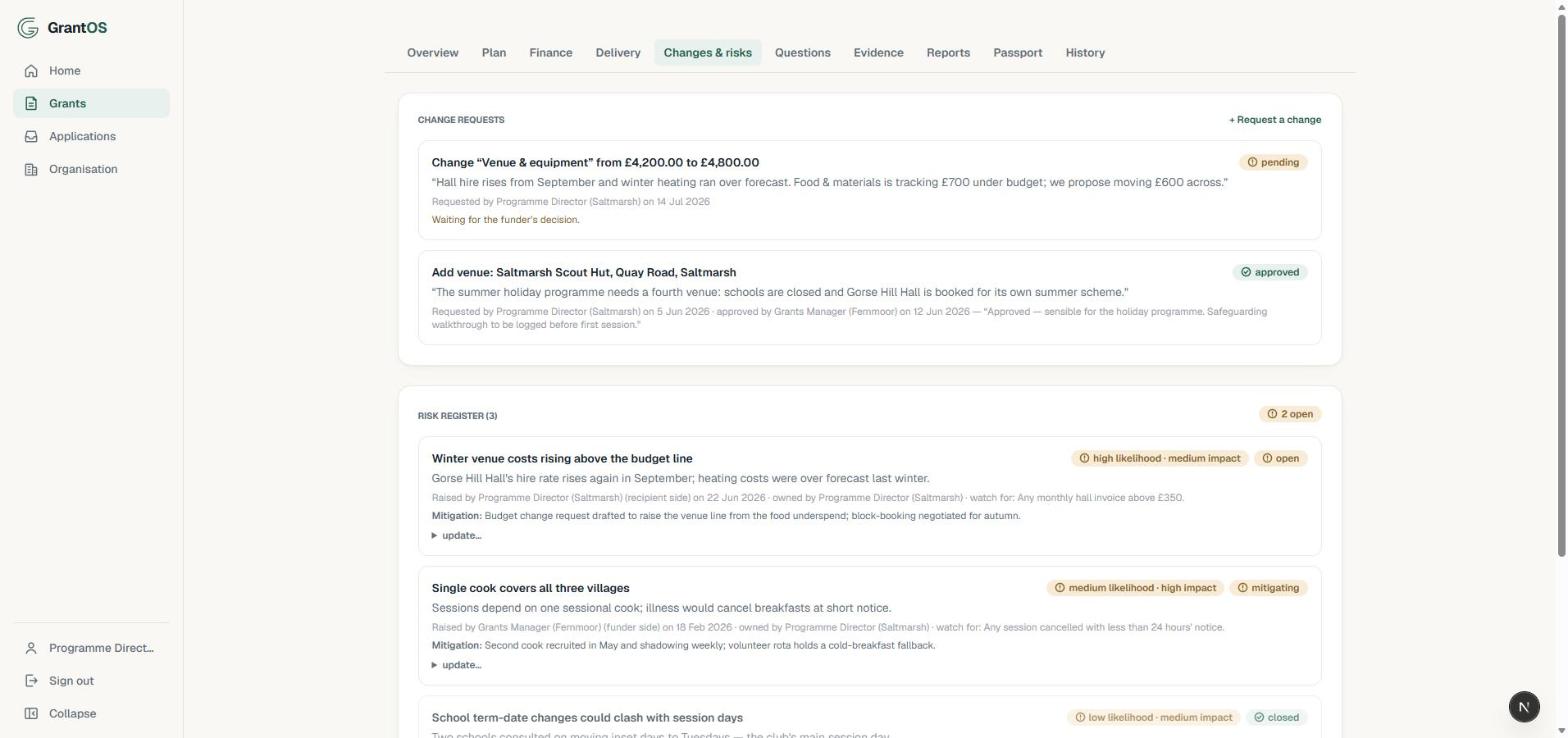
- Variation requests — venue, budget, timeline, scope — the funder's written decision versions the baseline; agreed tolerances say what may flex without asking.
- Shared risk register — either side raises risks with probability, impact, mitigation and what to watch for. “We told you in March — here's the record.”
- Questions on the record — the in-app replacement for the email chains grant disputes are made of; only the side that asked can close a question.
Telling the funder
Reporting & the audit pack
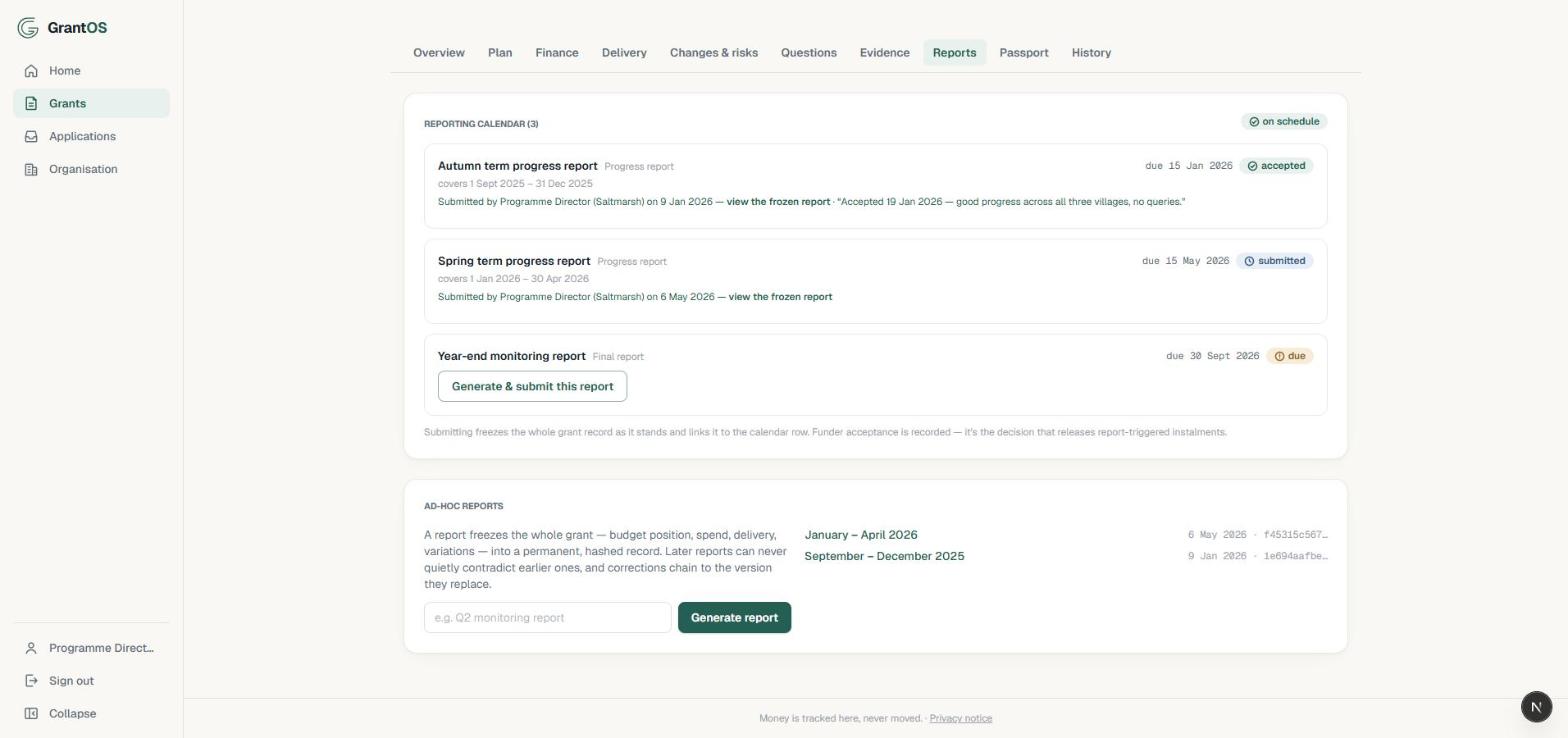
- Reports assembled, not written — frozen snapshots generated from the live record; corrections chain to the original, both stay visible.
- Acceptance releases payments — a funder accepting a report is the recorded decision that releases report-triggered instalments.
- One-click audit pack — a verifiable ZIP — hashed evidence, ledgers, milestones, outcomes and the event chain — against a published open format anyone can verify independently.
The organisation, held once
The organisation passport
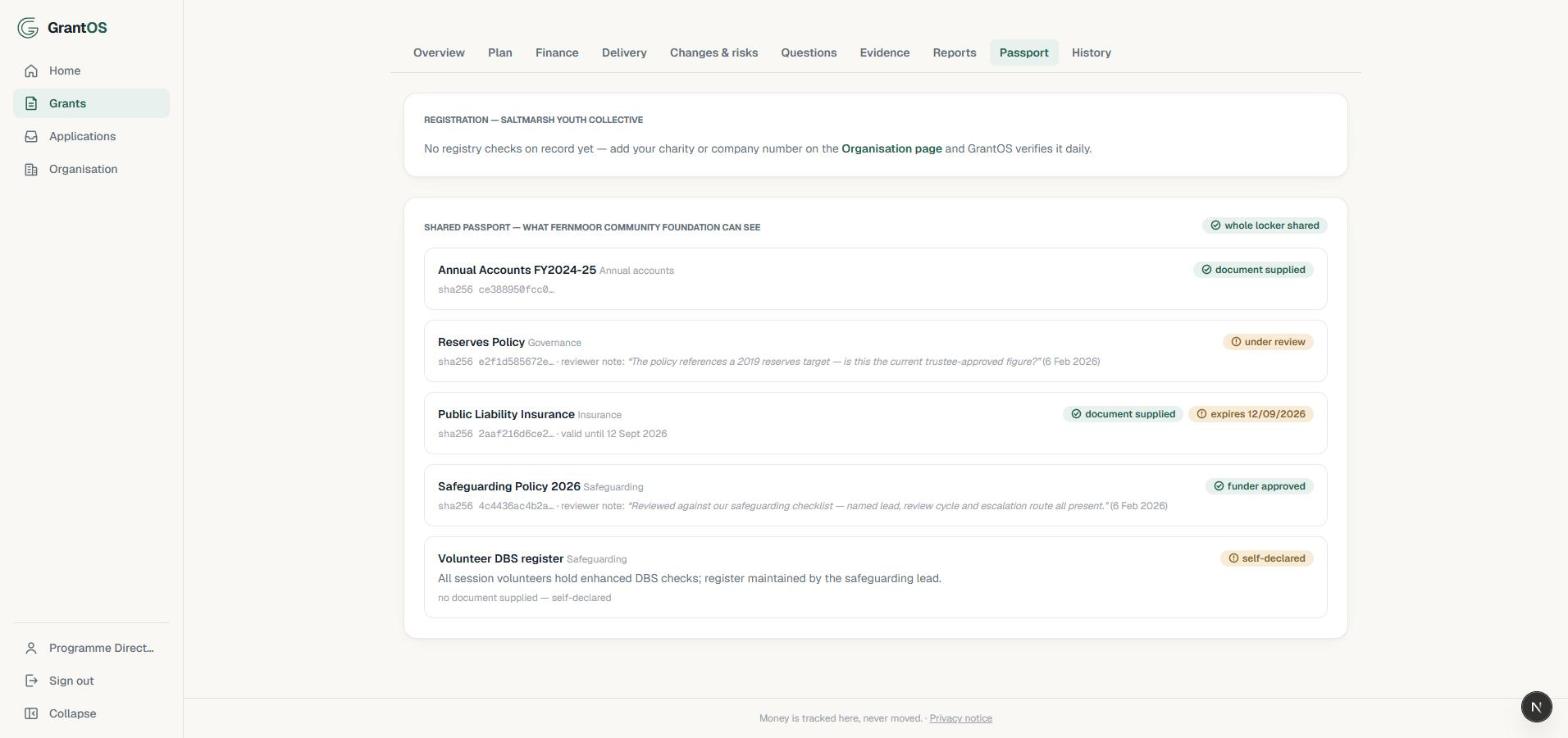
- Registry-verified — Charity Commission, Companies House and CIC status checked daily against the official registers — an independently confirmed status, not a claim.
- The evidence status ladder — every policy and document shows how far it's corroborated: self-declared → document supplied → funder approved. Claims and proof are never conflated.
- Shared on the charity's terms — the charity controls which funders see which categories, revocable any time — and both sides always see the same view.
Trust & access
Security, roles & the audit chain
- Two locks on every account — password plus mandatory authenticator app, with lockout and revocable sessions.
- 17 granular permissions — what the checkboxes show is exactly what the server enforces; auditors are read-only by design.
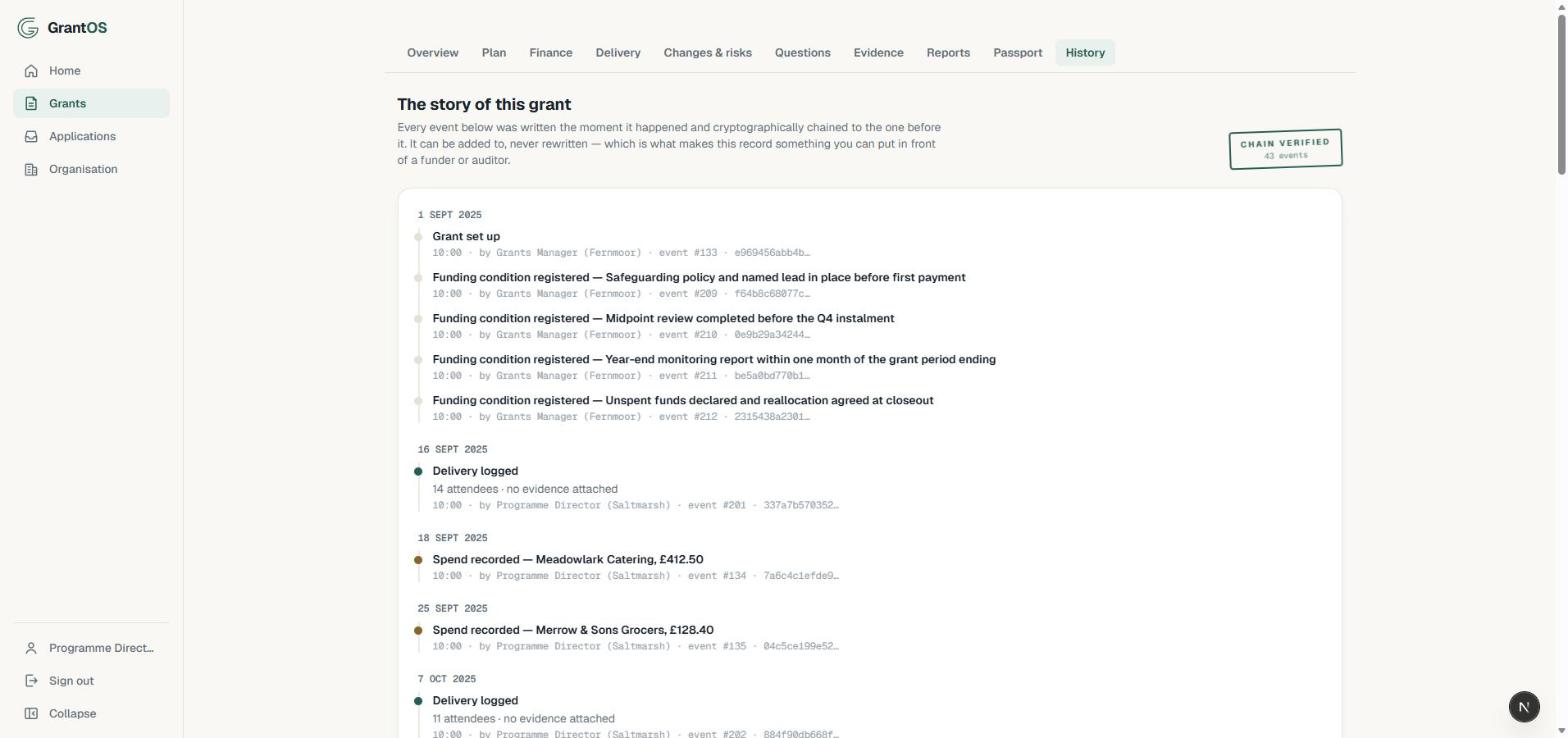
- Hash-chained, append-only audit trail — every change in the same transaction as its audit event; UPDATE and DELETE revoked at the database level; the chain re-verifiable on demand.